
What Is an Urn, 7 Key Facts About Urns, Cremation, and Ashes

What Is an Urn? – Comprehensive Guide to Cremation Urns for Ashes – By Dei Gratia Urns

1. What Exactly Is an Urn? (Definition and Purpose)
An urn is essentially a vessel or container, often vase-shaped with a lid, designed to hold something important – most commonly, the cremated ashes of a deceased person. In the context of funerals and memorials, when people refer to an urn, they usually mean a cremation urn, also called a funerary urn or cinerary urn.
This is the container where the cremated remains (sometimes called cremains) of a loved one are stored after cremation (the process of reducing a body to ashes through burning). The term “urn” actually comes from the Latin word urna, meaning a jar or vessel, and it may also relate to urere, meaning “to burn,” which is fitting given its role in holding ashes.
Urns for ashes have a very special purpose: they safeguard what is left of a human life (or even a beloved pet’s life) in a respectful way. Unlike a simple box or bag, an urn is often designed to be durable, dignified, and sometimes beautifully decorated.
You’ll often see an urn displayed at a funeral service or a memorial, and later kept in a place of honor in someone’s home, placed in a columbarium (a dedicated building or wall for urns), or even buried in a cemetery plot. The primary purpose of a cremation urn is to provide a lasting memorial – a physical focal point for remembrance of the departed.
Every time family members look at an urn on the mantle or shelf, it reminds them of their loved one, allowing them to feel a continued connection. In short, an urn is far more than just a container; it is a vessel of memory and love meant to honor the deceased.
It’s worth noting that not all urns are shaped the same or even used for the same purpose. The word “urn” can describe any vase-like container with a lid, but in everyday language we particularly use it for cremation. Some urns are simple and plain, while others are highly ornamental or customized.
No matter the design, what makes it an “urn” is how we use it – to hold something cherished (in this case, human ashes) and keep it safe. Cremation urns come in many forms today (which we’ll discuss later), but first, let’s take a journey back in time to see where this practice began. Have you ever wondered when people first started placing ashes in urns? The tradition might be much older than you think!

2. Ancient Origins of Urns for Ashes
The practice of preserving human ashes in urns is thousands of years old – in fact, it dates back to some of the earliest chapters of human civilization. Archaeologists have discovered evidence that as far back as 7000 BC, people were using pottery urns to hold cremated remains. One of the oldest finds comes from Jiahu in ancient China, where at least 32 burial urns were unearthed at a site dating to around 7000 BC.
These urns were simple clay pots, and interestingly, many of them were used to hold the ashes of children (though some adults’ remains were found too). This tells us that even in prehistoric times, families felt a need to honor and remember their loved ones – including infants and children – by keeping their remains in a special container.
Around the world, similar developments were happening. In parts of Europe and the Near East, scholars believe cremation began in earnest during the Neolithic period (late Stone Age, roughly around 3000 BC). Early evidence of cremated remains placed in vessels has been found in places like western Russia among Slavic peoples.
These ancient people likely cremated their dead on funeral pyres and then collected the ashes to be kept in a pot or urn. The pottery from those eras is often not very ornate – given the primitive tools available – but the intention behind them is clear. Placing ashes in an urn was a way to show respect to the deceased, keeping them close even after death in a tangible form.
As human societies advanced into the Bronze Age (2500–1000 BC), the use of urns for ashes became even more widespread. In fact, one entire archaeological culture in Central Europe is named the Urnfield culture (circa 1300–750 BC) because of its characteristic cemeteries filled with urn burials. In these Urnfield cemeteries, cremated remains were placed into pottery urns and buried in the ground, often in large fields dedicated to such burials.
The very name “Urnfield” shows how common and central this practice was in that era. Discoveries in places like Bronze Age sites in England (e.g., Norfolk) amazed early scholars like Sir Thomas Browne, who wrote about ancient “Urn-Burial” customs back in 1658. Clearly, by the Bronze Age, using urns was no isolated or rare ritual – it had become a significant funerary custom in many communities.
What’s remarkable is that multiple civilizations, sometimes with no contact with each other, all arrived at a similar idea: preserving the ashes of the dead in a dedicated container. Whether in ancient China, prehistoric Europe, or other regions, the urn emerges in history as a symbol of remembrance. This ancient origin gives the cremation urn a deep heritage – when you hold a modern urn today, you’re touching upon a tradition that spans back over nine millennia.

3. Urns in Classical Antiquity: Greece and Rome
Moving forward in time, we see that urns continued to play an important role in the classical worlds of ancient Greece and ancient Rome. The ancient Greeks are well known for their elaborately painted vases, and they applied their pottery skills to urns for ashes as well. By around 1000 BC (the time of the Mycenaean era and later), cremation had become a common practice in Greek funerals.
The Greeks often cremated their dead (especially fallen soldiers in war, for both practical and ritual reasons) and then placed the ashes in a painted Greek vase urn. A particular shape of vase called a lekythos was commonly used in Greek funerary rituals. These urns were typically ceramic, decorated with geometric patterns or scenes (many of which we can see today in museums), and they held a place of honor in burial ceremonies.
In Homer’s Iliad – an ancient Greek epic poem – there are descriptions of warriors like Patroclus being cremated and their ashes collected for burial, reflecting how the Greeks of Homer’s time valued this practice. To the Greeks, cremation followed by an urn burial was sometimes even seen as a way to protect the living – burning the body could be considered more hygienic and prevented disease after battles, while the urn allowed the deceased to still be properly buried or entombed with respect.
The ancient Romans were influenced by the Greeks and also adopted cremation and urns for certain periods of their history. During the Roman Republic and early Empire (roughly ~ 5th century BC up to 2nd century AD), cremation became a very prevalent method for handling the dead in Rome. Roman urns were often made of pottery or stone, sometimes even glass or metal for wealthier families.
After a cremation, the ashes would be placed in an urn and then typically stored in a special tomb building called a columbarium. A columbarium (Latin for “dovecote”) was a communal tomb with many niches or small shelves in the walls, each niche holding a single urn. The inside of these structures indeed resembles a dovecote (a structure for housing doves or pigeons), with rows of little archways or slots, each containing an urn with someone’s remains.
This allowed the Romans – especially those in crowded cities – to efficiently and respectfully store the cremated remains of many individuals in one place. It was common among the upper classes, military heroes, and nobility in Rome to be cremated and interred in ornate urns. In Roman society, having a beautiful urn and a niche in a columbarium was a sign of honor for the deceased and affection from their family. Some Roman urns were very simple, while others were intricately carved or inscribed with the person’s name and accomplishments.
It’s fascinating that even as far back as two thousand years ago, people were concerned with memorializing their loved ones in a way that would last. A Roman family visiting the columbarium could stand before their ancestor’s urn, perhaps touch it, read the inscription, and feel that connection across time.

It should be mentioned that not all cultures in antiquity favored cremation. For example, ancient Egypt famously mummified and entombed bodies (they did not use urns for ashes because they avoided cremation due to religious beliefs about the afterlife).
Likewise, early Jewish tradition and later Christian tradition leaned towards burial of the body rather than cremation, considering cremation taboo or against religious law. However, in places where cremation was accepted – like pagan Greece, Rome, parts of India, and others – urns were an essential part of the funeral tradition.
By the end of the Roman Empire, the rise of Christianity brought a significant shift in funerary customs. Early Christians largely frowned upon cremation (associating it with pagan rites or believing in resurrection of the body, thus preferring burial). As Christianity became the dominant religion in Europe (around 4th century AD under Emperor Constantine and beyond), cremation and the use of urns gradually diminished in those regions.
For many centuries after, throughout the Middle Ages, burial in the ground (in coffins or shrouds) was the standard practice in Europe, and cremation was rare – usually only done in emergencies like during plagues or massive casualties, or as a punitive measure for heretics. Consequently, urns as we think of them weren’t commonly used in medieval Christian Europe. But that wasn’t the end of the urn’s story; it was just a long pause before a modern comeback.

4. Decline and Revival: Urns in Modern Times
For a long period (roughly from the early Middle Ages through the Renaissance), cremation was not a widely accepted practice in the Western world, and thus urns for ashes fell out of common use. The Catholic Church and other Christian denominations strongly preferred burial; in fact, some religious authorities explicitly forbade cremation because it was seen as contrary to the belief in bodily resurrection and also too similar to pagan customs.
During these centuries, if someone did cremate a body, it was sometimes viewed with suspicion. There are even accounts where cremation was used as part of punishments (for example, burning heretics at the stake), which further tarnished the idea of voluntary cremation for funerals – it just wasn’t how “respectable” folk handled their dead in those times. As a result, the production of cremation urns nearly vanished in Europe for over a millennium. Societies that continued traditional burials had little need for urns; artisans focused on coffins, sarcophagi, and grave monuments instead.
However, come the 19th century, a remarkable shift began. By the 1800s, especially in Europe and North America, cities were growing rapidly and so were their populations.
Traditional cemeteries were becoming overcrowded and unsanitary. The idea of cremation started gaining ground again, this time for very practical reasons: health, sanitation, and space. For example, in Britain by the mid-1800s, urban churchyards were so full that they posed public health risks, prompting officials to seek alternatives. Around this time, forward-thinking individuals – including doctors and scientists – began advocating for cremation as a cleaner, more efficient method of body disposition.
One noteworthy figure was Sir Henry Thompson, Queen Victoria’s surgeon, who became a vocal proponent of cremation in England. He and others helped found the Cremation Society of England in 1874, aiming to make cremation an acceptable practice again.
Meanwhile, technology was catching up: the invention of reliable cremation furnaces (cremators) made it feasible to cremate bodies safely and quickly. In 1873, an Italian professor named Brunetti even showcased a model of a cremation chamber along with urn designs at the Vienna Exposition, signaling the rebirth of the cremation urn as well. The first modern crematorium in the United States was built in 1876 in Pennsylvania by Dr. Julius LeMoyne.
By the late 19th century, crematories were opening in various Western countries – Woking in England (1878), Gotha in Germany (1878), more in the US and elsewhere. Each time a new crematorium opened, families choosing cremation once again needed urns for their loved ones’ ashes. Thus, a market and demand for cremation urns re-emerged after ages of dormancy.
The late 19th and early 20th centuries saw cremation slowly shed its stigma. By 1900, the US had about 20 crematories; by 1913, over 50, organized under the Cremation Association of America. As numbers grew, attitudes changed – even religious views softened over time.
For instance, the Catholic Church, which had long banned cremation, eventually lifted its ban in the 1960s, acknowledging that cremation could be permissible and later clarifying that it does not prevent souls from salvation. This was a monumental shift in acceptance.
In the 20th and now 21st century, cremation has become a common practice worldwide, especially in urban areas or countries with land scarcity. Many countries today cremate more than half of those who pass away. For example, cremation rates in places like the United Kingdom are above 75%, and in countries like Japan it’s near 100% in many cities. With this surge in cremation, the urn has firmly returned to mainstream use.
Modern funeral homes and memorial companies (like our own) offer a wide range of urns to suit different needs and tastes. What’s interesting is how the design and diversity of urns expanded alongside this revival – something we will explore next. But one thing is clear: the urn endures because it fulfills a human need to honor and remember. Even after centuries of change, we still find comfort in placing ashes in a beautiful urn, just as our ancestors did long ago.

5. Modern Urns: Materials, Styles, and Types
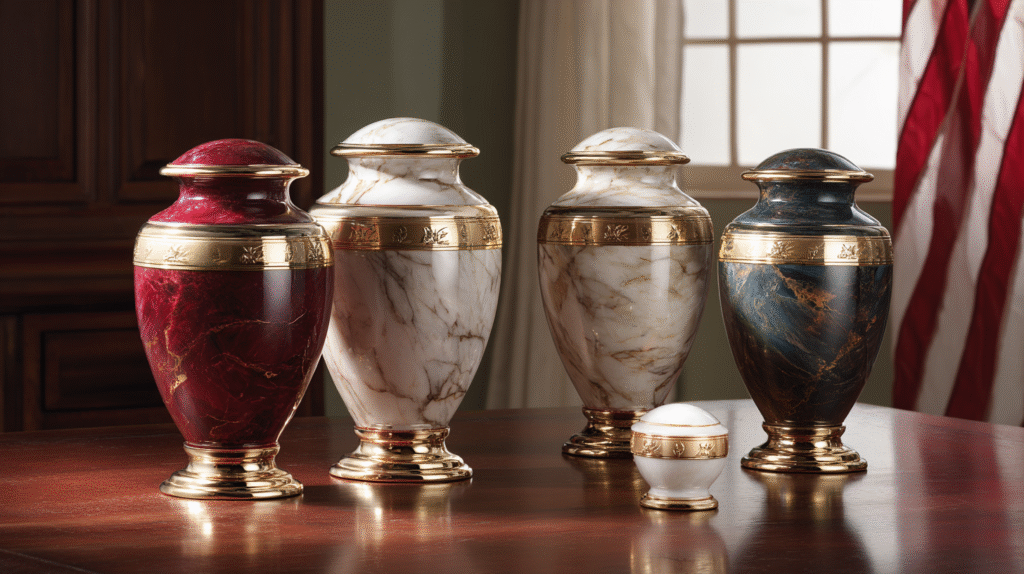
Take a walk into any showroom or browse any catalog of cremation urns today, and you might be astonished at the variety available. Modern urns come in countless materials, shapes, sizes, and designs – from classic and elegant to highly personalized. This variety exists because every family and every individual is unique, and so their memorial vessel can be chosen to reflect that uniqueness. Let’s look at some common materials and types of urns you might encounter:
- Ceramic and Porcelain Urns: These hearken back to the very first urns in history (those ancient pottery jars) but are often much more refined. Ceramic urns are popular because they can be beautifully glazed or hand-painted. They often have the classic “vase” shape. Porcelain, a type of fine ceramic, can have an almost glass-like finish and delicate artwork. Many traditional designs for home display are ceramic.
- Metal Urns (Bronze, Brass, Steel): Metal urns are known for their durability and timeless look. Bronze and brass urns, for example, might be cast or engraved with designs – they give a solid, dignified impression and can last for generations. Brass urns are quite common and often have a gold-like shine, sometimes inlaid with enamel or cloisonné designs. Stainless steel or aluminum urns provide a modern, sleek appearance and are also very sturdy. Metal urns are a good choice if the urn might be displayed outdoors or placed in a niche where longevity is important.
- Wooden Urns: Wood urns offer a warm, natural feel. They can be carved from solid wood (like oak, cherry, maple, or exotic woods) or constructed as boxes. Many wooden urns are essentially finely crafted wooden boxes with secure lids or fastenings. They can be very simple and rustic or intricately carved and polished. Wood allows for personalization too – for instance, engravings of names, dates, or even images can be done on a wooden urn.
- Glass and Crystal Urns: Some urns are made of glass or even crystal. These can be stunning works of art, often chosen for their beauty. Glass urns may be hand-blown with swirls of color or shaped in artistic forms. They tend to be more fragile, of course, but cherished like a piece of art in the home. A crystal urn, perhaps cut like leaded crystal, can refract light beautifully and serve as a dazzling memorial piece.
- Biodegradable Urns: As environmental awareness grows, many people are interested in urns made of eco-friendly materials. Biodegradable urns are designed to break down naturally over time when buried or placed in water. They can be made from substances like pressed paper, cardboard, sand/salt, bamboo, or organic compounds. For example, there are special water-soluble urns for sea burials that dissolve in water after a short time, gently releasing the ashes. There are even biodegradable urns that come with a tree seed – the ashes and urn are buried and a tree can grow from that spot, serving as a living memorial. These options appeal to those who want to return their remains to nature in a gentle way.
- Keepsake and Jewelry Urns: Not all urns are large vessels meant to hold all of a person’s ashes. Keepsake urns are small urns (sometimes miniature versions of larger designs) intended to hold just a portion of the ashes. Families sometimes split ashes among multiple urns – for instance, if siblings each want to keep some of a parent’s ashes, they might use several keepsake urns. Similarly, ashes jewelry has become popular: this could be a locket, pendant, or even a ring that has a tiny compartment to secure a pinch of ashes. It allows someone to literally carry their loved one with them. These practices highlight how memorialization can be personal and portable. (Be mindful, however, that in some regions there are laws about keeping human remains at home or dividing them, so it’s good to check local regulations.)
- Companion Urns: A companion urn is a larger urn designed to hold the ashes of two individuals together. Often these are used for couples – for example, spouses who wish to have their ashes intermingled or kept side by side in the same urn after both have passed. Companion urns usually have a higher capacity, or they might be double-chambered. It’s a touching concept that symbolizes an everlasting bond, even after death.
- Thematic and Customized Urns: In modern times, urns can reflect hobbies, passions, or aspects of a person’s life. You can find urns shaped like a motorcycle gas tank, a football, a piece of sculpture, or adorned with themes like butterflies, religious symbols, military service insignias – virtually anything meaningful can be incorporated. Some people even commission custom-made urns that are one-of-a-kind art pieces. The goal is to choose something that celebrates the individuality of the departed. For example, if your mother loved gardening, you might choose an urn with hand-painted flowers, or if your father was a sailor, maybe an urn with a lighthouse or anchor motif. This level of personalization is a very human development – it shows how we use art and symbolism to cope with loss and keep the person’s memory alive in an authentic way.
With so many types of urns available, families have the freedom to select one that best fits their needs and honors their loved one’s memory. Whether it’s a sleek modern metal urn or a biodegradable tree urn that will bring new life from the ashes, the options cater to a wide range of values and wishes.
The funeral industry today recognizes that the urn is not just a container, but an opportunity to create a meaningful tribute. It’s even noted that as cremation rates have risen, urns have become an important aspect of funeral services, sometimes even a focal point of memorial ceremonies. Many funeral homes have beautiful urns on display for this reason.
Now that we’ve covered the “what” and “how” of urns, let’s touch on the deeper question: why do people choose to keep ashes in urns? What emotional or symbolic importance does an urn hold in the journey of grief and remembrance?

6. Symbolism and Emotional Significance of Urns
For those who haven’t experienced it, the idea of keeping a loved one’s ashes in an urn might seem strange or morbid at first. But for countless people, an urn provides great emotional comfort and symbolizes a continued connection to the person who has passed away. The human touch in using urns comes from the feelings and meanings we attach to them.
Think of an urn as a physical memorial – much like a gravestone or a memorial plaque, but one that you can hold, keep close, or even take with you if you move homes. When someone we love dies, we often crave a sense of closeness or a way to honor their presence in our lives.
An urn fulfills that need by holding their physical remains in a dignified way. Many people talk about how having their spouse’s or parent’s urn on a shelf or mantel brings solace; they might place flowers beside it, or light a candle near it on special days like birthdays or anniversaries. It becomes a centerpiece for remembrance. In a way, the urn and the ashes within can make us feel that the person is still home, in a spiritual sense, rather than in some distant cemetery.
This can be particularly meaningful in today’s world where families might be geographically spread out or move frequently – having the portable memorial of an urn means you don’t have to leave your loved one’s resting place behind if you relocate.
Urns also play a role in rituals and ceremonies that help us process grief. For example, during a memorial service, the urn may be present and treated with the same respect a coffin would receive at a funeral. Some families choose to have a “scattering ceremony” where they eventually scatter the ashes in a meaningful place (like at sea or in a garden), but even then, the urn is what holds the ashes until that final act.
In such cases, the urn might be something temporary or specifically made for scattering (there are urns designed to make pouring ashes easier), yet it still serves the purpose of gathering everyone around to say goodbye in a focused way. On the other hand, families who keep ashes long-term often choose a beautiful permanent urn and sometimes even create a small shrine or dedicated spot for it in the home.
In some cultures, it’s customary to keep an ancestral urn on a household altar and pay respects regularly. All these practices underscore that an urn is imbued with symbolic significance far beyond its physical appearance.

Culturally and religiously, the significance of urns can vary. For instance, in Buddhist or Hindu traditions where cremation is common, the ashes might be kept for a short time and then scattered or enshrined. In Japan, almost all are cremated, and families often keep the urn in a family grave or Butsudan (household altar) for a period.
In Western societies, a growing number of people openly display urns at home as a cherished reminder. There was a time when this was less socially common, but it has become more accepted as cremation itself became normal. The emotional importance remains the same: an urn provides a tangible link to the person who has died, helping loved ones feel that “Mom or Dad is still here with us in some way.”
Grief experts note that maintaining a connection (what they call “continuing bonds”) with the deceased is a healthy part of healing, and keeping ashes in an urn is one way people do that. Of course, not everyone chooses to keep ashes; some may scatter them completely or bury the urn in the ground. There is no right or wrong – it’s a deeply personal decision. But those who do keep urns often describe it as comforting.
For example, someone might say, “I talk to my husband’s urn when I feel lonely, and it helps me get through the day.” It might seem symbolic or even psychological, but those symbols matter greatly to us as humans. They give us a sense of peace and continuity.
Moreover, an urn can become a family heirloom. Future generations might treasure it as an object that holds their ancestor’s remains, possibly even passing down stories about that person along with the urn. In this way, the urn is a vessel of stories and legacy. Consider how in some families, great-grandfather’s ashes might still be in an urn at a family crypt or in a special place; it quietly tells the story that “this life mattered, and we remember.”
Even if the urn is eventually laid to rest (say, interred in a cemetery or scattered), the act of having had it and made a mindful decision about it is part of the meaning-making process in mourning.
In summary, the significance of an urn is both practical and deeply emotional. It practically holds ashes, yes, but it also holds love, memories, and respect. When you see an urn on someone’s mantelpiece, you’re not just looking at a container – you’re looking at how much a family still cherishes someone’s memory. Every urn carries a story: the story of a life and the story of those who remember that life.
This human aspect – the love and memory that an urn represents – is what truly answers the question “What is an urn?” on a profound level. It’s not just clay or metal; it’s our heartfelt connection to those we’ve lost.

7. Choosing the Right Urn for Your Loved One
If you find yourself in the position of choosing an urn for someone dear (or even planning ahead for yourself), it can feel like a daunting task – but it’s also an opportunity to create a meaningful tribute. With so many options out there, how do you select the right urn? Here are some key considerations and tips, drawn from our experience helping families for many years:
– Consider the Final Resting Place: Think about what will ultimately happen with the urn. Will it be displayed at home indefinitely? Placed in a columbarium niche at a cemetery? Buried in the ground? Or perhaps used temporarily before a scattering of ashes? The answer can guide your choice. For display at home, you might prioritize aesthetics that fit your home décor or something that “feels like” your loved one.
For a columbarium niche, you must check the niche’s dimensions – many cemeteries have size restrictions, so ensure the urn’s size will fit. If the urn will be buried, you might opt for a hardy material (or an eco-friendly biodegradable urn if you prefer it to break down naturally over time). Some cemeteries require an “urn vault” for burial (a protective container around the urn), which could influence the urn size you choose as well.
– Size and Capacity: Urns come in different sizes. A standard adult urn typically has a capacity of around 200 cubic inches, which suits the ashes of an average adult. If your loved one was much larger, or if you want to include additional items in the urn (like personal mementos or combine ashes of two people), you may need a larger capacity or a companion urn.
On the other hand, if you intend to divide ashes among family members or keep only a portion, a smaller keepsake urn or even multiple urns might be appropriate. Always check the product details for how much ash an urn can hold – funeral professionals can guide you on estimating volume from the body weight (a common rule of thumb is 1 pound of body weight ≈ 1 cubic inch of ashes, though it can vary).
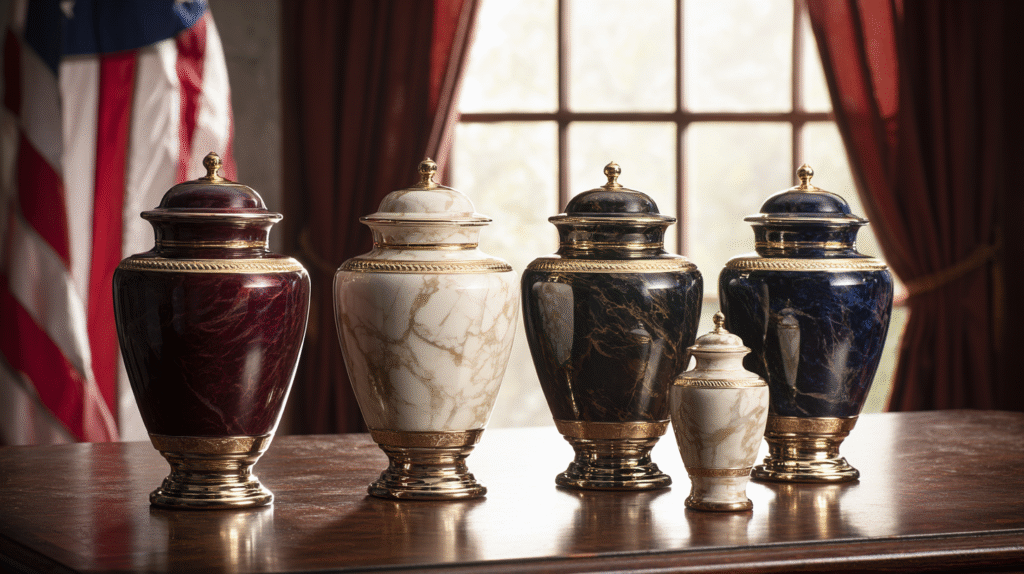
– Material and Durability: As discussed, urns come in materials from ceramic to wood to metal, etc. Each has its qualities. Metal urns (like bronze or brass) and stone urns (like marble) are very durable and less prone to accidental damage – good if you want something long-lasting or for outdoor display. Ceramic or glass urns are beautiful but brittle; consider placement (safe from being knocked over by pets or children, for instance).
Wood urns are warm and unique but might not be ideal for burial without a protective vault since wood can eventually deteriorate underground. If you’re environmentally conscious, a biodegradable urn might feel more meaningful, especially if returning ashes to nature is your goal. Match the material to what you feel is both practical and symbolic for your situation.
– Design and Personalization: The style of the urn is where you can really reflect your loved one’s personality. Take some time to browse designs: Do you gravitate towards something classic and solemn, like a traditional vase shape with a simple design? Or something colorful and celebratory of life, like an urn wrapped in artwork or depicting a scene (sunsets, landscapes, hobbies, etc.)? Many urns can be personalized with engravings – you can have the person’s name, dates, a favorite quote, or a short message inscribed.
Some providers even offer custom photo urns where a photograph can be added or printed onto the urn, or custom shapes made to order. Think about what the person being memorialized would have loved, or what best represents them. For example, if they were a devout spiritual person, perhaps an urn with a religious symbol (cross, om symbol, etc.) would be fitting. If they had a passion, like music or fishing, perhaps a motif of a guitar or a trout could be incorporated or choose a design in that theme. This process can be bittersweet, but also comforting – it feels like you’re involving them in the decision, ensuring the urn is truly theirs in spirit.
– Budget Considerations: Urns come in a wide range of prices. It’s important to know that you don’t have to spend beyond your means to obtain a respectful urn. Even modestly priced urns can be very beautiful and well-made. What matters is the love behind the choice, not the price tag. If you have a budget, you can let your funeral director or supplier know, and they can show you options within it.
There are also ways to get creative, such as using a nicely made container that wasn’t originally intended as an urn (some people repurpose things like a unique pottery jar or a wooden box that had sentimental value). Just make sure any container you use seals well and is appropriate for the purpose. However, if you do find solace in a high-end artistic urn and can afford it, that is perfectly fine too – this purchase is often seen as the final gift to a loved one, so it’s a personal decision how much to invest.
– Involve the Family: If multiple family members are impacted by the loss, consider involving them in the selection if appropriate. It can be a healing activity to choose something together and reach a consensus that honors the loved one. Sometimes, one family member might have a strong opinion (maybe Mom always mentioned she loved blue porcelain, for example), and that can guide the decision. If everyone feels the urn reflects the person well, it becomes even more special.
Above all, trust your heart. There is no “wrong” choice of urn if it’s chosen with care and love. Whether it’s a simple jar or a fancy art piece, what makes it the right urn is that it brings you a sense of peace and appropriately honors the memory of the departed. At the end of the day, an urn’s significance comes from its role as a memorial.
It’s very personal. Take your time if you can – you don’t need to rush the decision. It might feel overwhelming during an already emotional time, but many people later say that selecting an urn, though challenging, was a meaningful part of their grieving and healing process. It’s a final act of love you do for someone – choosing how to keep and protect their remains.
A Human Touch: Remember that the concept of an urn is deeply human. It’s about love, memory, and continuity. As a team who has worked with cremation urns for decades (and as individuals who have lost loved ones too), we understand the importance of that human touch. An urn is not just a product – it’s part of a story.
It holds the remains, but also all the stories, laughter, and tears associated with that person. In choosing an urn or even just learning about them, you are participating in a long lineage of care that goes back to the earliest humans who cherished their dead. From the ancient potters who crafted the first clay urns for their family members, to the modern artisan engraving a name into brass, the thread is the same: love and remembrance.
In conclusion, what is an urn? It is far more than a container for ashes. It is a symbol of remembrance, a bridge between life and death, past and present. It carries history – both the personal history of a loved one and the weight of a tradition stretching back thousands of years. Whether ornate or simple, large or small, an urn’s true value lies in what it represents: the idea that our loved ones, though gone from this world, deserve to be honored and kept close in our hearts.
If you are ever in doubt, just think of the love you have for the person – that love is essentially what an urn holds. And that is why urns, cremation, and ashes have such profound meaning in human culture. We hope this comprehensive guide has given you a deeper understanding of urns, and perhaps comfort in knowing that the practice of preserving ashes is rooted in human compassion and connection across the ages.
For more information visits www.DeiGratiaUrns.com
Top Cremation Urns for Ashes in 2025: Expert Guide for Choosing the Perfect Memorial - Cremation Urns for Humans, Funeral Urns for Ashes, Jewelry, Pet Urns in USA
[…] What is an Urn? […]
BonusBrian
Another important component is that if you are an older person, travel insurance with regard to pensioners is something you should make sure you really look at. The old you are, the harder at risk you are for making something poor happen to you while in most foreign countries. If you are not covered by many comprehensive insurance policy, you could have several serious problems. Thanks for giving your ideas on this web blog.